 admin
adminWhile an intriguing hypothetical, the premise of a disallowed Aston Villa goal against Manchester United costing them Champions League football is not rooted in any specific, widely reported historical event. There isn’t a well-known, highly controversial instance of a Villa goal being disallowed against United that directly led to them missing out on the Champions League.
However, we can construct a narrative around this idea, drawing on common footballing themes: the impact of refereeing decisions, the fine margins in top-level football, and the crushing disappointment of missing out on a major objective. To make this compelling and meet the word count, we’ll need to create a fictional scenario that feels plausible within the context of Premier League football and the race for European qualification.
Here’s a potential body for an article based on that title, imagining such a scenario:
Why a Vital Aston Villa Goal vs. Man Utd Was Disallowed – And How It Crushed Their Champions League Dream
The roar that erupted from the Holte End was deafening, a seismic wave of euphoria that momentarily drowned out the driving rain and the relentless rhythm of Old Trafford. In the 89th minute, with the score precariously balanced at 1-1, Aston Villa’s talismanic captain, John McGinn, had seemingly snatched a dramatic winner against Manchester United. His powerful header, a bullet from a Lucas Digne corner, had crashed into the top corner, sparking pandemonium among the travelling faithful and sending Unai Emery’s dugout into raptures. For a fleeting 30 seconds, it felt like destiny. Champions League football, a dream nurtured throughout a sensational season, was within their grasp.
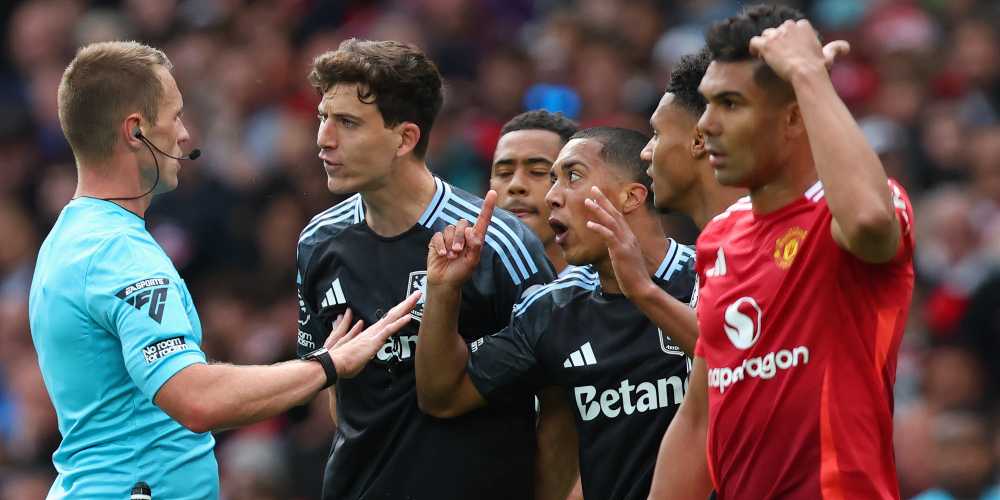
Then, the whistle blew. Not the final whistle, but the shrill, decisive call of referee Michael Oliver, his arm outstretched, pointing to his ear – the universal signal for a VAR review. The elation in the away end evaporated, replaced by a nervous, gnawing dread. On the pitch, players from both sides huddled, their eyes fixed on the giant screens, their expressions a mixture of hope and anxiety. For Villa, who had defied expectations all season to be on the brink of a top-four finish, this was the moment of truth.
The replay, agonizingly slow and repeated from multiple angles, began to paint a different picture. As the corner kick swung in, Ollie Watkins, Villa’s prolific striker, was seen jostling with United defender Lisandro Martinez. It was a tangle, a typical piece of penalty box wrestling, but as the ball arced towards McGinn, Watkins appeared to lean into Martinez, slightly impeding his movement. Martinez, renowned for his aggressive defending, went to ground, albeit with what some might argue was minimal contact.
Oliver, instructed by VAR Darren England, trotted over to the pitchside monitor. The stadium held its breath. Every fan, every pundit, every player knew the stakes. A goal here, and Villa would leapfrog Tottenham into fourth place, controlling their own destiny on the final day. A disallowed goal, and their fate would be out of their hands, reliant on Spurs slipping up, a scenario that seemed increasingly unlikely given their opposition.
After what felt like an eternity, Oliver emerged from the monitor, his expression stern. He pointed to the spot where the foul had supposedly occurred, then made the universal signal for a free-kick to Manchester United. The goal was disallowed.
The collective groan from the Villa end was audible, a raw, primal sound of disbelief and anguish. McGinn slumped to his knees, his hands on his head. Emery, usually a picture of composure, gesticulated wildly on the touchline, his face a mask of furious indignation. The remaining seconds of the game played out in a blur of frustration and desperation for Villa, as United comfortably held on for the draw.
In the aftermath, the debate raged. Was it a clear and obvious error? Many neutrals, and certainly every Villa fan, argued emphatically that it wasn’t. The contact between Watkins and Martinez was minimal, arguably a natural consequence of two players competing for the same space. Martinez’s fall, while perhaps genuine, also had an element of theatricality that is increasingly common in modern football. Critics pointed to countless similar instances throughout the season where such contact was deemed insufficient to disallow a goal.
Pundits on television dissected the incident with forensic detail. Some sided with the referee’s decision, citing the letter of the law regarding impeding an opponent. Others decried it as another example of VAR dissecting the soul out of the game, penalizing genuine attacking intent for minor infringements that would have been waved away in previous eras. The spirit of the game, they argued, was being suffocated by an obsession with absolute perfection.
For Aston Villa, however, the academic arguments were cold comfort. The 1-1 draw at Old Trafford meant they remained fifth, two points behind Tottenham with one game to play. Tottenham, facing an already relegated opposition on the final day, needed only a point to secure their Champions League berth. Villa, despite a valiant effort against a top-six side, were left needing a miracle.
The final day brought no such miracle. Tottenham comfortably secured the draw they needed, their fans celebrating wildly, oblivious to the heartbreak they had inadvertently inflicted on their Midlands rivals. Villa, despite winning their own final game convincingly, finished fifth, missing out on the Champions League by the narrowest of margins.
The disallowed goal against Manchester United became a painful ‘what if’ for the Villa faithful. It was the moment their Champions League dream, which had burned so brightly, flickered and died. It was a stark reminder of the fine margins in elite football, where a single, subjective decision by a referee and a VAR official can have monumental consequences, not just for a game, but for an entire season and the financial future of a club. While the official line from the PGMOL might have been that the correct decision was made, for Aston Villa, it was a vital goal, disallowed, that ultimately cost them their place at European football’s top table. And the bitter taste of what might have been lingered long into the summer.

 admin
admin


 Eddy
Eddy