 X
XA heated storm erupted after a highly controversial decision that left players, managers, and fans in absolute disbelief. The moment the referee pointed to the spot, the stadium atmosphere shifted instantly—confusion, frustration, and anger blending into a single, explosive reaction. And at the centre of it all was the furious outburst: “If that counts as a penalty, then you’d have to award one in every single match.”
This wasn’t just a simple complaint. It was a full, emotional eruption that captured exactly how unfair and inconsistent officiating can feel in the heat of a competitive game. For the person making this statement, the decision wasn’t just harsh—it was the very definition of injustice in football. In his eyes, the call represented everything wrong with modern officiating: inconsistency, overreliance on subjective interpretation, and a complete loss of common sense.
He argued passionately that if such minimal contact—barely enough to shift the attacker’s balance—was enough to justify a penalty, then football would become unrecognizable. Every slight touch, every minor collision, every shoulder-to-shoulder challenge could suddenly be interpreted as a foul worthy of a spot kick. The game, he claimed, would no longer be about strength, skill, and fair competition. Instead, it would be reduced to a series of soft calls, cheap advantages, and undeserved goals.
In his lengthy frustration, he broke down exactly why the decision made no sense. First, he insisted that the defender had done absolutely nothing out of the ordinary. It was a natural defensive movement, a moment every defender experiences dozens of times in a single match. He neither shoved, pulled, nor obstructed his opponent illegally. Instead, it was a routine challenge, the kind football has always allowed—until decisions like this started surfacing.
Second, he emphasized that the attacker clearly exaggerated the contact. The fall was dramatic, unnecessary, and obviously intended to influence the referee. To him, it was a deliberate attempt to deceive the officials and cheat the system. Awarding a penalty under such circumstances, he argued, only encouraged more theatrical falls and rewarded players who chose to manipulate the situation rather than fight honestly for the ball.
Third, he questioned the use of VAR. With video review available, he found it unacceptable that the officials watched the replay and still concluded the incident was worth a penalty. To him, this wasn’t just a mistake—it was an embarrassing failure, a moment that highlighted how unclear and poorly regulated the rules around contact in the box had become. He insisted that technology should bring clarity, not chaos, and should prevent errors, not amplify them.
He continued by expressing how decisions like this can ruin the rhythm of a match. A team can defend bravely, fight with intensity, and maintain control, only to lose everything because of a referee’s weak, inconsistent call. Momentum shifts, morale drops, and suddenly a match that should be decided by quality and tactical superiority becomes dictated by officiating choices. For him, that was completely unacceptable.
As he ranted further, he pointed out that incidents identical—or even worse—occur in nearly every game without consequences. Defenders get pushed, shirts get pulled, strikers go down at the slightest touch, yet referees choose to ignore them. But on this particular occasion, in this particular moment, a decision was made that contradicted typical standards of fairness. It was that inconsistency that made him furious. Football, he insisted, requires steady, predictable officiating. Without it, teams cannot understand what is allowed or forbidden, making the game chaotic and irritating.
He warned that if referees continue interpreting such ordinary contact as a penalty, then no game would end without one. Premier League, Champions League, international fixtures—every match would feature whistle after whistle, penalty after penalty, until fans could no longer even enjoy the sport. The physical aspect of football would disappear entirely, and defending would become nearly impossible. And once defending becomes impossible, the whole balance of the sport collapses.
His statement was more than frustration. It was a plea for the integrity of the game. He called for officials to use more common sense, apply rules consistently, and rely less on exaggerated reactions from players. Football, he argued, must remain a sport where challenges are allowed, strength is celebrated, and referees trust their instincts rather than being swayed by theatrical performances.
By the time he finished speaking, his message was clear: the decision was not only wrong but dangerous for the future of the sport. And his final line echoed across every headline:
“If that counts as a penalty, then we might as well give one in every game.”
A statement born from frustration, but rooted in a deep desire to protect the spirit of football.


 Eddy
Eddy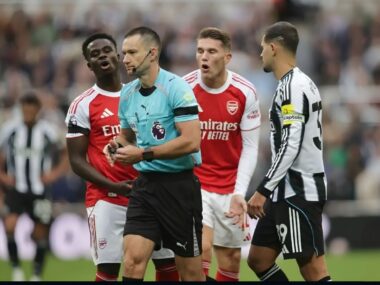
 Oojays_gram

 admin
admin