 X
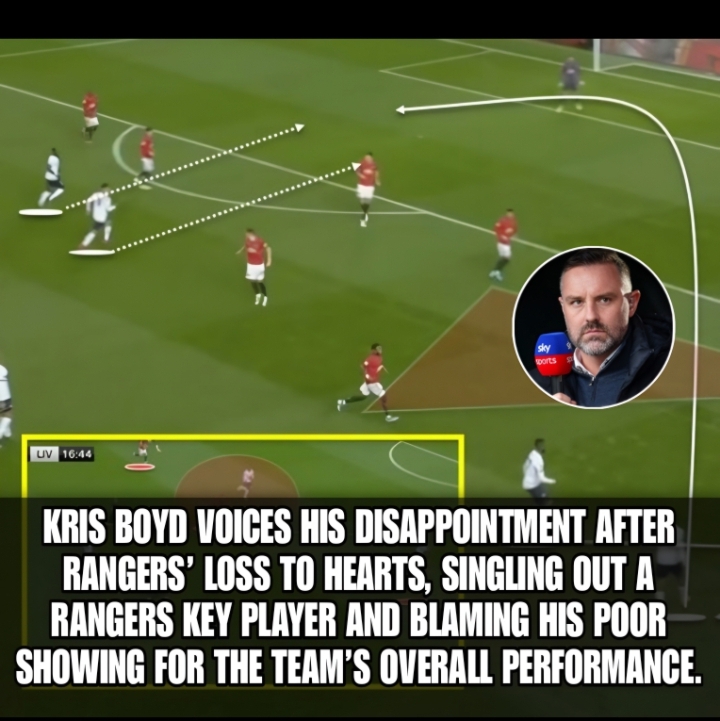
XRangers’ recent defeat to Hearts has sparked a storm of criticism, and none louder than that coming from pundit Kris Boyd. The former striker, known for his blunt and uncompromising analysis, did not hold back when assessing the performance of one particular Rangers player during the clash. According to Boyd, the player’s display was far below the standard expected at this level, and it played a central role in the team’s disappointing result. His words were sharp, direct, and left little room for interpretation. “When you want to win, you don’t play like that,” Boyd stated, capturing his disbelief and frustration at what he witnessed on the pitch. The comment, though simple, carried the weight of experience and authority, highlighting a performance that, in his view, failed to meet the demands of professional football.
Boyd’s criticism did not stop at general disappointment. He went further to place direct accountability on the player, implying that his individual shortcomings significantly contributed to Rangers’ inability to secure a positive outcome. In his analysis, Boyd stressed that such a performance cannot be excused, especially in high-stakes matches where consistency and focus are crucial. He underscored the idea that the team’s collective failure in that match was, in large part, tied to the lackluster showing of this key figure. Fans watching the game would have noticed moments where the player appeared sluggish, uncoordinated, or simply out of sync with the rhythm of the team. Boyd’s commentary highlighted these instances, suggesting that the mistakes were not random but symptomatic of a poor mindset or preparation.
The second part of Boyd’s critique extended to the responsibility of Rangers’ head coach, Danny Röhl. He warned that starting this player in the next game could prove to be a serious mistake. “Danny Röhl should not make the mistake of starting him next game,” Boyd emphasized. This remark is telling because it signals a loss of faith in the player’s immediate ability to contribute positively to the team. Boyd’s statement also places pressure on the coaching staff, suggesting that the decision-making regarding team selection must be strategic and reflect performance levels. It is a reminder that professional football is unforgiving: poor performances can have immediate consequences, both for players and for those responsible for fielding them.
The intensity of Boyd’s remarks reflects not only his passion for Rangers but also his deep understanding of the game. Having spent years playing at the highest level, he recognizes that success is built on discipline, effort, and the ability to deliver when it matters most. His disappointment is therefore rooted in a combination of high expectations and professional insight. It is not uncommon for pundits to express frustration after underwhelming performances, but Boyd’s delivery is particularly cutting because it singles out the individual responsible rather than diffusing the blame across the team. This kind of criticism is often polarizing among fans—some will agree wholeheartedly with Boyd’s assessment, while others may feel it is too harsh or unfair. Regardless, it sparks discussion and debate, which is a hallmark of passionate football culture.
The context of the match adds further weight to Boyd’s criticism. Rangers, a club with a storied history and high standards, were expected to dominate or at least compete strongly against Hearts. A loss in such circumstances is always disappointing, but when coupled with the visible underperformance of a player who is supposed to be influential, it becomes a talking point that cannot be ignored. Boyd’s comments, therefore, serve as both a critique of the individual and a broader commentary on the team’s preparedness and mental state. The implication is clear: if Rangers are to meet their ambitions this season, every player must rise to the occasion, and those who falter risk scrutiny and replacement.
The reaction to Boyd’s statements has been immediate. Fans have taken to social media to share their opinions, with many echoing his frustration while others defend the player, citing factors such as injury, fatigue, or poor service from teammates. This kind of debate is common in football, particularly after disappointing results. However, Boyd’s reputation and authority in the game give his words significant weight. When a former professional publicly questions a player’s ability and suggests that the coach reconsider their inclusion in the lineup, it sends a message that performance standards must be met without excuses.
In sum, Kris Boyd’s reaction to Rangers’ loss against Hearts highlights the uncompromising nature of professional football analysis. His blunt statement, “When you want to win, you don’t play like that,” encapsulates his disbelief at the player’s performance, while his advice to Danny Röhl not to start him in the next game underscores the seriousness of the situation. The criticism is sharp, focused, and leaves no doubt as to where Boyd places responsibility. For the player in question, it is a wake-up call that the expectations at a club of Rangers’ stature are high, and failure to meet them can attract public scrutiny. For the team and coaching staff, it is a reminder that preparation, selection, and individual performance all contribute to collective success—or failure. The debate that follows will be closely watched by fans, pundits, and analysts alike, as it highlights the pressures and accountability inherent in top-level football. Boyd’s forthright commentary ensures that this performance—and its consequences—will not be easily forgotten.


 X
X

 Abdulhaq27

 Oojays_gram