 X
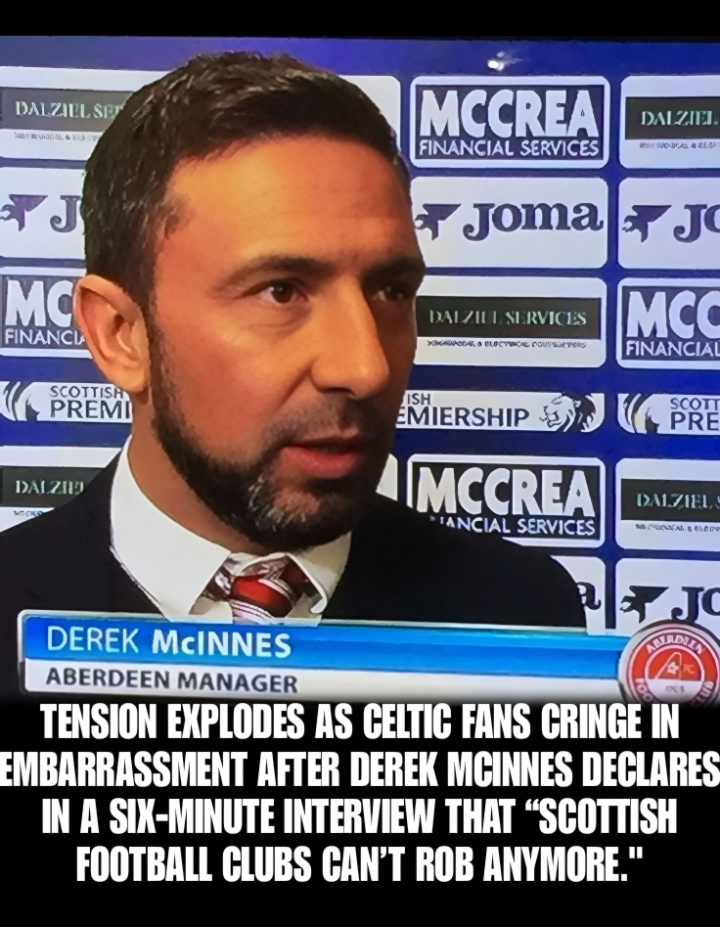
XIn the world of Scottish football, moments of raw honesty often ignite more fire than anything that happens on the pitch. That is exactly what unfolded after Derek McInnes appeared in a live interview that quickly turned the entire football community upside down. What began as a routine media moment transformed into a spectacle that Celtic supporters are still trying to wrap their heads around. McInnes didn’t shout, he didn’t insult anyone directly, and he didn’t even seem angry — yet his calm, almost amused responses carried more weight than a heated rant ever could.
The interview lasted only a few minutes, but every second seemed to hold a quiet sting. Viewers could sense something unusual even before he spoke about Celtic. There was a particular moment, subtle but unmistakable, when the interviewer mentioned the club’s name. Instead of giving the typical respectful nod or the diplomatic pause managers usually adopt, McInnes let out a small laugh. It wasn’t loud, and it wasn’t mocking in an obvious way, but it was the type of laugh that said more than any strongly-worded comment ever could. It suggested disbelief, amusement, and maybe even a little frustration all wrapped in one simple reaction.
That laugh alone sent a shockwave through social media. Celtic fans felt it instantly — the sense that their club had just been dismissed, brushed aside with nothing but a short chuckle. For rival fans, the moment was pure entertainment. They replayed the clip again and again, turning it into memes, captions, and endless banter. But what came next from McInnes made the moment even more explosive.
When the interviewer pressed further, asking for McInnes’ thoughts on Celtic’s recent performance and their reputation for turning games around with controversial decisions, he didn’t hold back. But he didn’t attack them directly either. Instead, he spoke in a way that felt almost surgical — precise, controlled, and devastating. He explained that Celtic had no advantage this time, no questionable calls falling in their favour, no moment of luck to lean on. If they had plans to dominate, those plans remained just that: plans. Nothing materialized. Nothing shifted the match in their direction. If there were whispers about Celtic “escaping with three points,” McInnes made sure to emphasize, in his own polite but pointed way, that nothing of the sort happened.
He didn’t use the word “robbery,” but he didn’t need to. The implication was crystal clear. If there had ever been days when Celtic snatched victories out of nothing, this wasn’t one of them. They were stopped cold. They were contained. They were neutralized. It was a message delivered softly, but the impact hit hard.
Celtic fans didn’t know how to respond at first. Some tried to brush it off, insisting that managers talk like this all the time. Others felt embarrassed — not because McInnes had insulted their club, but because he seemed genuinely amused at the mere mention of them. And that reaction burned more than an angry rant ever could. There’s something about laughter that makes criticism feel sharper, and Celtic supporters understood that immediately.
Meanwhile, neutral viewers and rival supporters loved every second of it. They praised McInnes for his composure and the almost effortless way he dismantled Celtic’s reputation without raising his voice or using aggressive language. In a football culture where managers often repeat the same clichés and predictable excuses, McInnes’ straightforwardness felt refreshing — even liberating.
The interview also sparked a larger conversation about Celtic’s current form. Many fans of the club have been voicing concerns for months, pointing out cracks in the squad, inconsistencies in performance, and lingering questions about their tactical approach. McInnes’ comments, subtle as they were, seemed to confirm what many had already been whispering: Celtic no longer intimidates the way they once did. The aura that used to surround the club has dimmed, and opponents are beginning to talk about them with less fear and more confidence.
Of course, Celtic supporters quickly rallied online, arguing that McInnes was simply enjoying a brief moment of success and that his comments were overblown by the media. Some insisted that Celtic would respond on the pitch in the coming weeks, proving that the club remains a powerhouse whether rivals laugh or not. Others acknowledged the sting but claimed it would only motivate the team further.
But regardless of how supporters tried to spin it, the truth remained: McInnes delivered a message that echoed far beyond the interview, and the football world couldn’t look away. His calm, almost amused delivery made every word heavier, every sentence more impactful. It wasn’t a rant. It wasn’t an insult. It was something far more dangerous — honesty mixed with confidence.
And in football, that combination always leaves a mark.

 admin
admin
 X
X
 Rasheed
 Abdulhaq27