 admin
adminYou’re looking for a more in-depth exploration of Don Hutchinson’s criticism, expanding on the initial points and delving into potential specifics and broader implications. Here’s a more substantial body for your article:
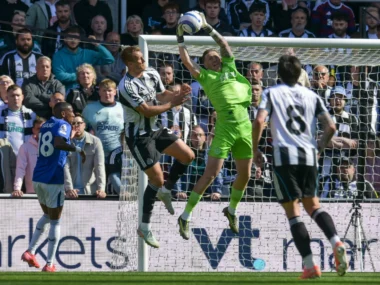
Don Hutchinson, a seasoned former Premier League midfielder known for his forthright analysis, delivered a scathing assessment of a £30 million Everton player’s performance against Manchester City, labeling a particular action as “unforgivable.” While acknowledging the formidable challenge that Manchester City presents to any opponent, Hutchinson’s sharp critique suggests a level of individual failure that transcended the expected difficulties of facing the reigning champions. His strong words imply a significant lapse in judgment, a costly error, or a moment of inexcusable negligence that directly impacted the outcome or the flow of the game.
The phrase “all over the place” in the title hints at a broader disjointedness in the player’s performance leading up to the specific “unforgivable” incident. This suggests a lack of positional discipline, inconsistent decision-making throughout the match, or a general failure to adhere to the tactical instructions laid out by the Everton manager. Such a lack of cohesion not only undermines the team’s structure but also leaves them vulnerable against a side as ruthlessly efficient as Manchester City, who are adept at exploiting any hint of disorganization.
The “unforgivable” act itself likely occurred during a critical juncture of the match. It could have manifested in several ways: a glaring defensive error that directly led to a Manchester City goal, a reckless challenge resulting in a penalty or a red card, a crucial missed opportunity in front of goal that could have altered the game’s trajectory, or a blatant disregard for tactical responsibilities that left teammates exposed. Hutchinson’s strong condemnation suggests that the error wasn’t a mere technical misstep but rather a fundamental flaw in the player’s application, awareness, or temperament in a high-pressure situation.
Given the £30 million price tag associated with the player, Hutchinson’s criticism carries added weight. Such a significant investment implies an expectation of a higher standard of performance, particularly in crucial matches against top-tier opposition. When a player acquired for such a substantial fee commits an “unforgivable” error, it inevitably raises questions about the scouting process, the player’s suitability for the team’s style of play, and their mental fortitude under pressure. It also amplifies the scrutiny on the manager’s team selection and tactical approach.
While the title refrains from naming the player, the Everton fanbase and football pundits alike would undoubtedly be speculating intensely about their identity. Potential candidates might include players in key defensive positions where errors are often magnified, or attacking players who failed to capitalize on rare opportunities. The context of the game – the scoreline, the timing of the incident, and the overall performance of the team – would further inform this speculation.
Hutchinson’s analysis likely went beyond simply identifying the mistake. As a former professional, he would likely have dissected the sequence of events leading up to the error, highlighting the underlying causes and the decision-making process (or lack thereof) that contributed to it. He might have questioned the player’s focus, their understanding of their role, or their ability to handle the tactical demands of facing a team of Manchester City’s caliber.
The repercussions of such an “unforgivable” act can be significant. Internally, it could erode the trust between the player and their teammates and the manager. It might lead to disciplinary action, a spell on the sidelines, or a reassessment of their role within the squad. Externally, it fuels fan frustration and media criticism, further intensifying the pressure on both the player and the club.
Moreover, such individual errors can have a detrimental impact on the team’s morale and confidence. When a costly mistake is made, particularly by a senior or high-profile player, it can create a sense of unease and undermine the collective belief in achieving a positive result. Against a team as dominant as Manchester City, maintaining focus and minimizing errors is paramount, and an “unforgivable” lapse in concentration can be ruthlessly punished.
Hutchinson’s strong language also underscores the high stakes involved in Premier League football, where even minor mistakes can have significant consequences. The financial implications of dropped points, the impact on league position, and the potential damage to reputation all contribute to the intense scrutiny faced by players at this level. A £30 million price tag only amplifies these expectations and the severity of criticism when those expectations are not met.
In conclusion, Don Hutchinson’s condemnation of a £30 million Everton player’s “unforgivable” act against Manchester City points to a significant individual failing that likely had a tangible negative impact on the team’s performance. His assessment, coupled with the “all over the place” description, suggests a broader lack of composure and tactical discipline from the player in question. This incident not only highlights the intense pressure on high-value signings to perform consistently at the highest level but also underscores the unforgiving nature of Premier League football, where costly individual errors against top opposition can be severely punished and draw sharp criticism from seasoned professionals like Hutchinson. The fallout from this incident will undoubtedly be a key talking point for Everton supporters and football analysts alike, raising questions about the player’s future contribution and the overall standards within the team.


 lukman
 admin
admin
 Eddy
Eddy
 X
X